Arman Behnam
Current Positions
- Researcher, Quis
- PhD in Computer Science, Illinois Institute of Technology · advised by Dr. Binghui Wang
- Editorial Board Member, American Journal of Lifestyle Medicine (AJLM), and SAGE Research
- Reviewer, NeurIPS (Conference on Neural Information Processing Systems). ICLR (International Conference on Learning Representations)· ICML (International Conference on Machine Learning). AAAI (Association for the Advancement of Artificial Intelligence).
Some Personal Background
Arman Behnam is a Researcher at Quis and a Computer Science PhD at Illinois Institute of Technology, advised by Dr. Binghui Wang. His research covers Internal World Models (IWM), personalized AI, AI-human understanding, and causal explanation, representation, and reasoning in graphs and large language models. He is the first author of the breakthrough SaCRL (structure-agnostic causal representation learning framework) published at NeurIPS 2026.
With numerous papers published in top-tier venues, Arman Behnam is a recognized rising star researcher in the global AI community. His career spans significant industry-academic collaboration, including roles as AI Research Scientist at Mayo Clinic, where he published a breakthrough human memory paper at IEEE BIBM alongside world-renowned Alzheimer’s expert Dr. Ronald Petersen.
Before moving to the United States, Arman was a prominent AI/ML educator and practitioner in the Middle East. Starting as a self-taught lecturer sharing machine learning videos online, he built an community of over 30,000+ followers. This momentum led him to become the youngest lecturer at Jahad Daneshgahi Sharif (the most prestigious AI and technology institution in Iran) at age 22, teaching over 10,000+ students. Later, he also served as the Founding Head of AI Data Science at Golrang Industrial Group (100+ subsidiaries), where he established and led its centralized ML division.
My ResearchMy research is centered on Internal World Models, causal machine learning, and personalized AI, with the ultimate goal of giving AI a real soul to unlock a radically new era of human-machine relationship. This requires a fundamental leap from task completion to authentic emotional depth, beginning with Internal World Models that map how human emotional states and behavioral patterns continuously unfold. |
Selected Research
|
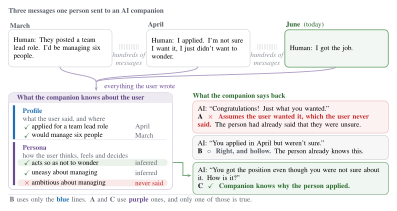
Arman Behnam, Sunglyoung Kim, Liangwei Yang paper / dataset / code The first benchmark built from real, months-long relationships between people and an AI companion: 10 people and 27,218 messages over up to 120 days, with every label traced to the messages behind it. It shows that people rarely refer back to earlier messages, that AI cannot tell when the past matters, and that AI assumes things about people that they never revealed. |
|
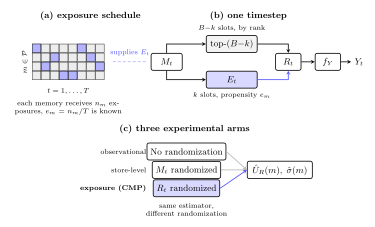
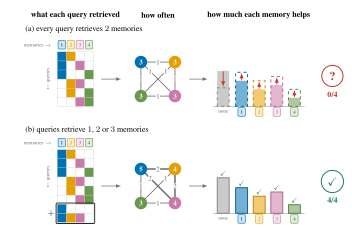
Arman Behnam, Binghui Wang paper / code AI memory systems judge each memory by its effect when retrieved, so a memory that is never retrieved has no measurable value. This happens for 54–67% of needed memories on standard benchmarks. CMP fills a few retrieval slots at random with known probabilities, which makes every memory's value measurable without bias, and improves separating needed from unneeded memories from 0.54 to 0.66 AUC. |
|
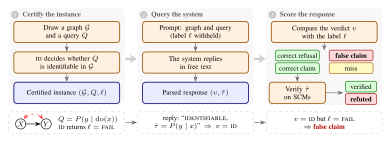
Arman Behnam, Binghui Wang paper / code Ask a reasoning model whether a causal effect can be computed from data, and it may return a confident formula for a question that has no valid answer. No amount of data can ever reveal that mistake. CertID is built to catch it: the complete ID algorithm certifies whether each question can be answered at all, and every formula a model returns is checked exactly against causal models whose true answers are known. Testing Gemini Flash, Gemini Pro, and GPT-5.5 on the same questions, we find that their rates of these false claims differ widely, so accuracy alone says little about whether a model's causal reasoning can be trusted. |
|
Arman Behnam paper / code A memory agent can judge its memories only from its retrieval log, but that log often cannot separate one memory's contribution from another's. We prove that top-k retrieval leaves every memory's value undetermined, however many episodes are logged, and on 14 standard benchmarks no value is determined in any of 55 configurations. LEDGER reports which values the log does determine, with confidence intervals, and retrieves so that more become determined: on pooled HotpotQA, from 0.1% to 79.7% of memories. |
|
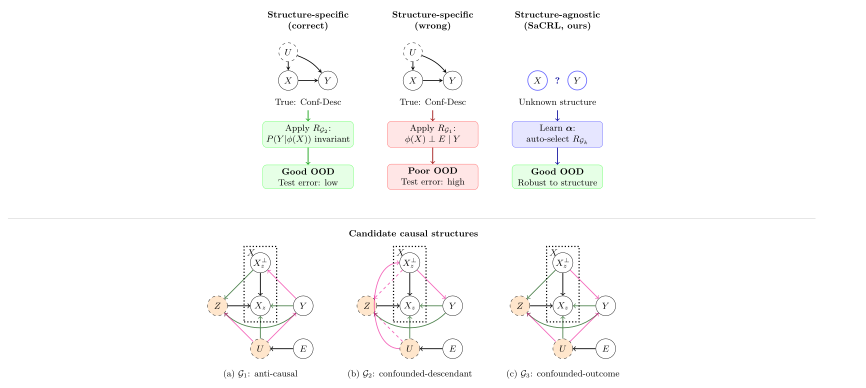
Arman Behnam, Binghui Wang NeurIPS; 40th Annual Conference on Neural Information Processing Systems; December 2026 paper / code / poster Causal representation learning usually requires knowing the causal structure in advance, and choosing the wrong one throws away useful information. SaCRL learns the structure and the robust representation together, with guarantees for identifying the structure and generalizing out of distribution. It recovers the true structure on synthetic benchmarks and reaches state-of-the-art accuracy on PACS, VLCS, and OfficeHome. |
|
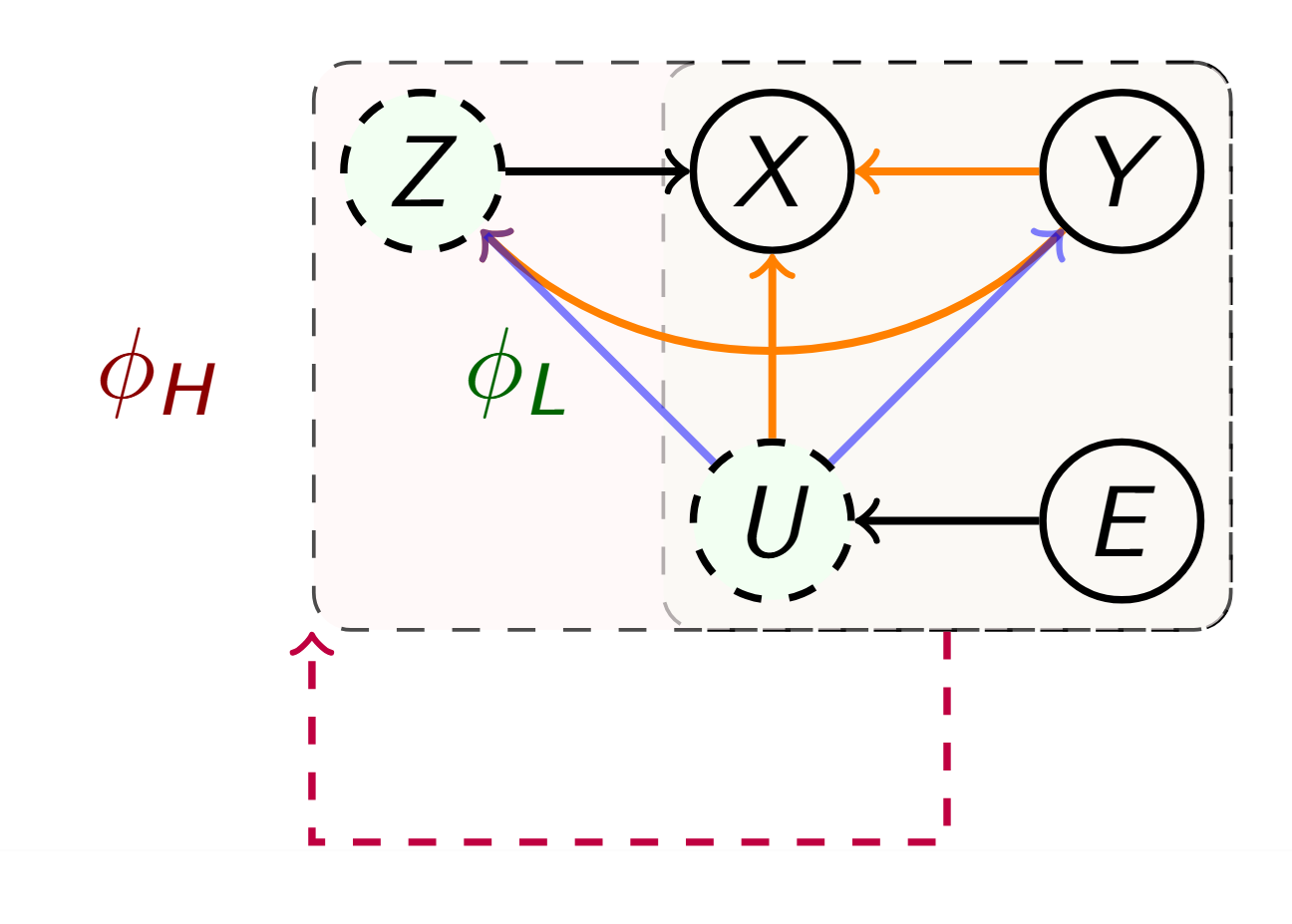
Arman Behnam, Binghui Wang NeurIPS; 39th Annual Conference on Neural Information Processing Systems; December 2025 paper / project / code / poster / openreview In many tasks the label causes the observation, while most robust learning methods assume the reverse. We give a measure-theoretic framework for this anti-causal setting that learns environment-invariant features under both perfect and imperfect interventions, with guarantees for generalizing out of distribution. It outperforms state-of-the-art methods on CMNIST, RMNIST, Ball Agent, and Camelyon17. |
|
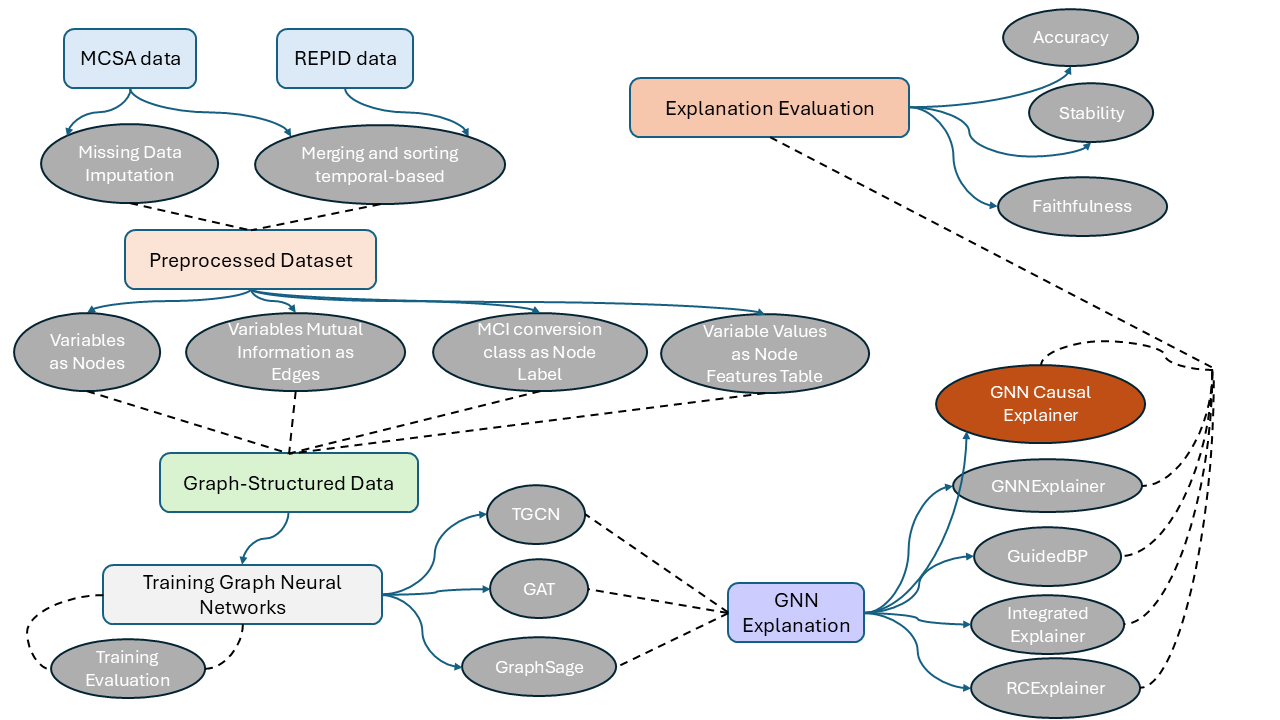
Arman Behnam, Muskan Garg, Xingyi Liu, Maria Vassilaki, Jennifer St. Sauver, Ronald C. Petersen, and Sunghwan Sohn IEEE BIBM; International Conference on Bioinformatics and Biomedicine; December 3rd, 2024 paper / code / video We represent patients' chronic diseases, biomarkers, and genetic data over time as a graph, and use graph neural networks to find the causal drivers of mild cognitive impairment (MCI) progression. The causal subgraph we identify points to hypertension, arrhythmia, heart failure, coronary artery disease, stroke, lipid disorders, and sex. |
|
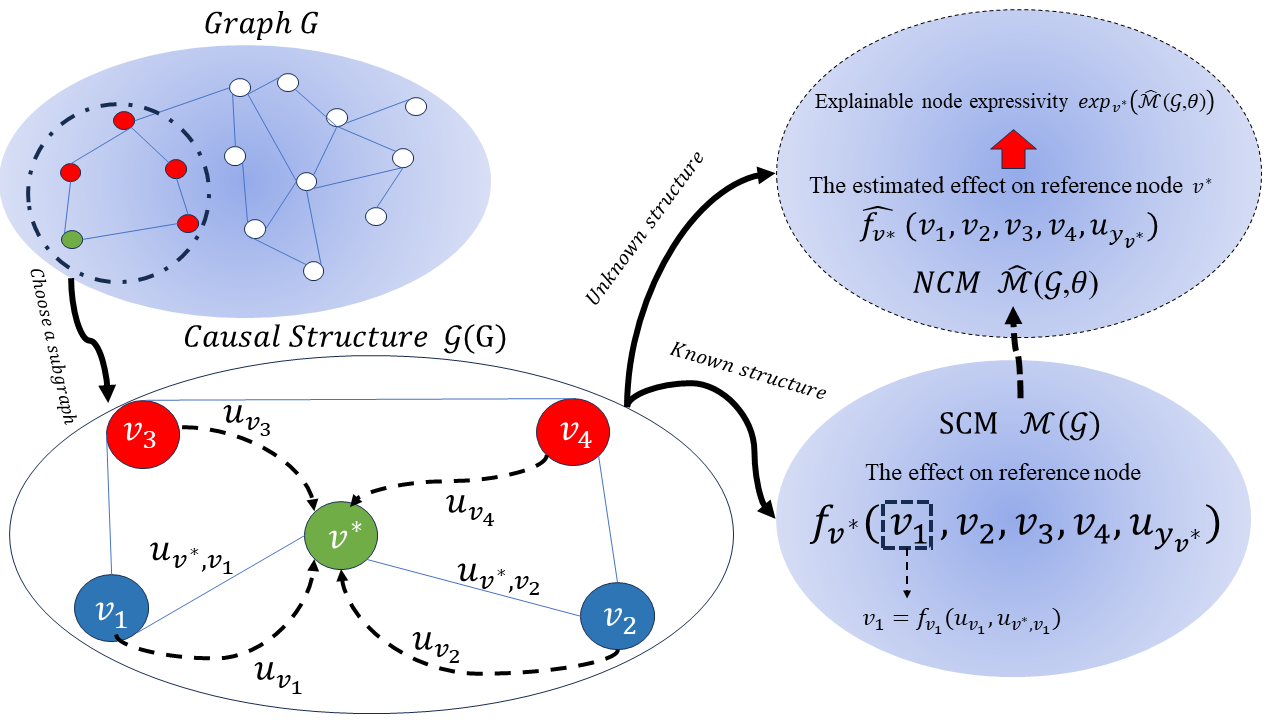
Arman Behnam, Binghui Wang ECCV; 18th European Conference on Computer Vision; July 2024 paper / code / video Most GNN explainers highlight the parts of a graph that correlate with a prediction. CXGNN, the first causal explainer for GNNs, builds a neural causal model of the graph and trains it to find the subgraph that causally explains the prediction. It recovers ground-truth explanations more accurately than both association-based and causality-inspired explainers. |
Other publications ▾
- GroundedPersona: Grounding Personalized Human Understanding from Long-Term Human-Agent Conversations. Sunglyoung Kim, Arman Behnam, Liangwei Yang. LASS Workshop at ACM CIKM, 2026.
- Artificial Intelligence–Enabled Internet of Things Technologies in Modern Energy Grids. Book chapter, IoT Enabled Multi-Energy Systems, Academic Press, 2023.
- Data Science Leverage and Big Data Analysis for Internet of Things Energy Systems. Book chapter, IoT Enabled Multi-Energy Systems, Academic Press, 2023.
- Meta-Health Stack: A New Approach for Breast Cancer Prediction. Healthcare Analytics, 2022.
- A Data Analytics Approach for COVID-19 Spread and End Prediction (Case Study in Iran). Modeling Earth Systems and Environment, 2021.
- A Comparison Between Different Classifications for Predicting Metastasis in Breast Cancer. IIIEC, 2021.
- A Study on IoT Applications and Technologies in Logistics. Book chapter, Logistics and Supply Chain Management, 2020.
Full list on Google Scholar.